
How the RSW and CDL Low Pressure Screw CompressorAir Ends Work
The RSW or CDL oil-free low pressure screw compressor airend, also known as “helical screw” compressor, is a positive displacement machine that uses rotary motion.
It delivers constant flow (volume) and variable pressure. This means that at a given speed (rpm), the screw air end always supplies the same amount of air, independent of pressure variation.
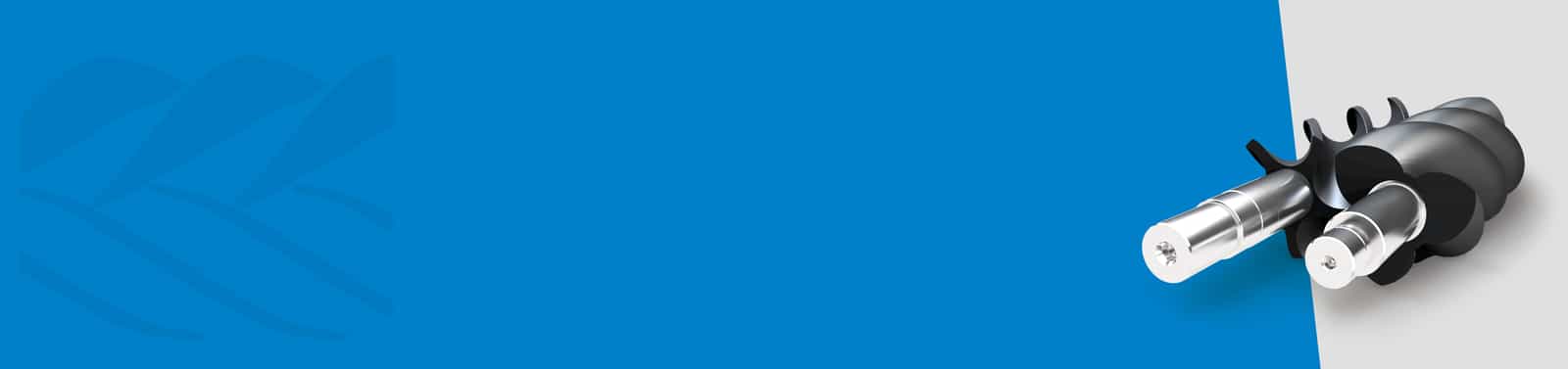
The RSWand CDL low pressure screw air ends consist of a pair of helical profile rotors. One male rotor with 3 convex lobes and one female rotor with 5 concave lobes or “flutes” contained in a casing.
While maintaining precise alignment by means of timing gears, the rotors turn in opposite directions. They mesh to form a series of working chambers between the rotors and the casing wall.
The gas is sucked from the intake side (suction), trapped between the rotors and the casing (radially) and the cover (axially). It is then transported to the compression side (discharge) where the working chamber shrinks, and air is compressed.
The polytropic (internal) compression supplies a steady air flow. This minimizes vibration and maintenance, while maximizing the lifetime of the device.
Since there is no oil for sealing (oil-free screw), the rotors have very precise and small tolerances. This maintains a very small air gap between the two in order to guarantee optimal performance without touching each other and minimize the volumetric losses.
The air-cooled RSW low pressure screw air end can reach a maximum pressure ratio (outlet pressure divided by inlet pressure) of 3,5.