

Industries and Applications
Wastewater Treatment
Industrial Wastewater Treatment
Aquaculture
Environmental
Chemical and Pharmaceutical
Food and Beverage
General Manufacturing
Lime and Cement
Medical
Mining
Plastics
Power Generation and Oil & Gas
Pulp and Paper
Products
Positive Displacement Blowers
Digital Solutions
Turbo Blower
Multistage Centrifugal Blowers
Side Channel Blower
Low Pressure Screw Compressor
Rotary Lobe Blowers
Screw Blowers
Vacuum Pumps
Centrifugal Pumps
Roots blower
Engineered to Order
Parts & Service
Find Parts and Kits
Genuine Parts
Lubricants
Service & Repair
Service and Maintenance Plans
Ancillaries
About Us
About Us
Careers
Global Presence | Robuschi
Knowledge Base
Discover & Learn
Select & Specify
Operate & Maintain
News
Events

Full Case Study

Operators at the Röthenbach an der Pegnitz wastewater treatment plant in Germany needed a more efficient way to manage biological aeration—especially during medium to peak loads. Their existing setup required switching between a 30 kW screw blower and a 55 kW rotary piston blower, which was inefficient and labor-intensive.

The solution: the Robuschi ROBOX Turbo Blower TS30/2-08.

Learn how the Robuschi turbo blower helped Röthenbach optimize oxygen delivery, reduce maintenance, and improve effluent quality.
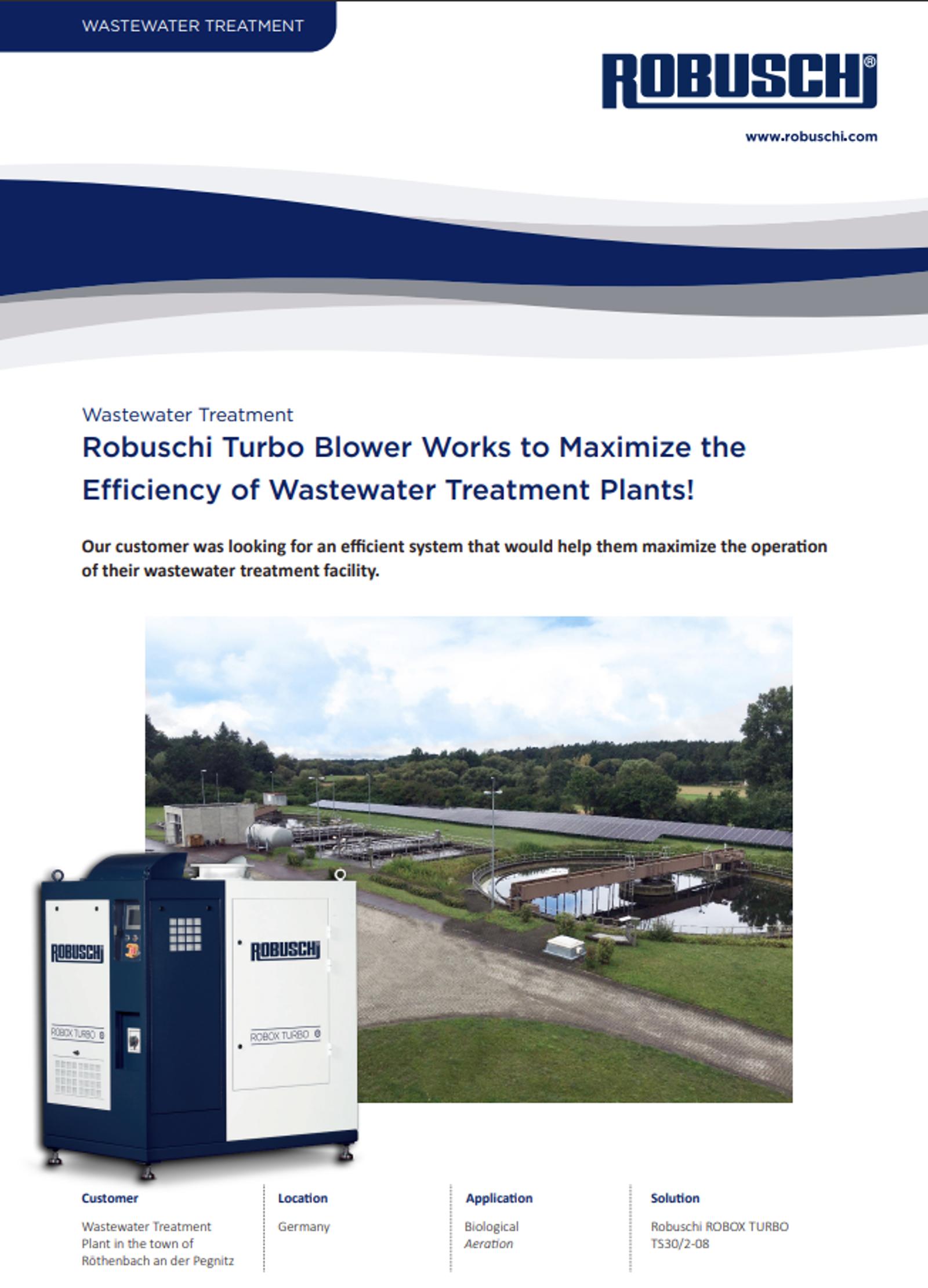
Turbo Blower Boosts WWT Plant Efficiency Case Study

Key Outcomes

  • Single blower replaces two: The TS30/2-08 covers a wide flow range (9–21 m³/min), eliminating the need to alternate between two blowers.
  • Stable oxygen levels: Continuous aeration maintains 2 mg O₂; intermittent zones reach 1.6 mg O₂ quickly.
  • Improved effluent quality: Lab results show stable or improved COD, NH₄-N, NO₂-N, NO₃-N, and BOD₅ values.
  • Lower maintenance: Less foam, fewer solids, and extended cleaning intervals for probes.
  • Energy efficiency: Same 30 kW power input now handles peak loads, reducing energy waste.

Why It Worked

1. Wide Operating Range

The TS30/2-08’s performance curve matched the plant’s variable demand, allowing it to handle up to 2,250 m³ across three aeration sections without switching equipment.

2. Seamless Integration

Despite the plant’s legacy control system, the turbo blower was integrated using Modbus and 4–20 mA signals. A tailored PLC program ensured stable oxygen delivery across load conditions.

3. Operational Simplicity

The blower’s HMI panel made it easy to monitor and adjust settings. Automatic restart after power failures added resilience.

4. Maintenance Savings

No belts, oil, or greasing required. Contactless air bearings reduced noise and wear. Foam formation and sludge buildup were minimized, cutting down on manual cleaning.

Country

Industry

Your request will be forwarded to the relevant individuals to assist with your request.
By clicking 'Send' you are authorizing Generic Brand to contact you so that we may fulfill your request, as well as to communicate with you regarding our products and services.
Terms and Conditions
Privacy Policy

(* required fields)

FAQs

Its wide flow range, energy efficiency, and low maintenance design make it ideal for biological aeration processes with fluctuating loads.