

Industries and Applications
Wastewater Treatment
Industrial Wastewater Treatment
Aquaculture
Environmental
Chemical and Pharmaceutical
Food and Beverage
General Manufacturing
Lime and Cement
Medical
Mining
Plastics
Power Generation and Oil & Gas
Pulp and Paper
Products
Positive Displacement Blowers
Digital Solutions
Turbo Blower
Multistage Centrifugal Blowers
Side Channel Blower
Low Pressure Screw Compressor
Rotary Lobe Blowers
Screw Blowers
Vacuum Pumps
Centrifugal Pumps
Roots blower
Engineered to Order
Parts & Service
Find Parts and Kits
Genuine Parts
Lubricants
Service & Repair
Service and Maintenance Plans
Ancillaries
About Us
About Us
Careers
Global Presence | Robuschi
Knowledge Base
Discover & Learn
Select & Specify
Operate & Maintain
News
Events

Full Guide

Food and beverage processors face rising costs and tightening regulations around wastewater treatment. Water is central to every stage of production—from ingredient processing to equipment cleaning—yet much of it ends up as high-load effluent. The challenge is twofold: reduce water consumption and treat wastewater efficiently without driving up energy and maintenance costs.

This guide from Robuschi outlines how to optimize wastewater treatment (WWT) using low-pressure air systems and robust equipment designed for variable loads and harsh environments. It breaks down the treatment process into four stages and highlights how Robuschi’s PD blowers and screw compressors support each step with energy-efficient, low-maintenance performance.

Get the complete breakdown of wastewater treatment stages, equipment specs, and performance benchmarks.
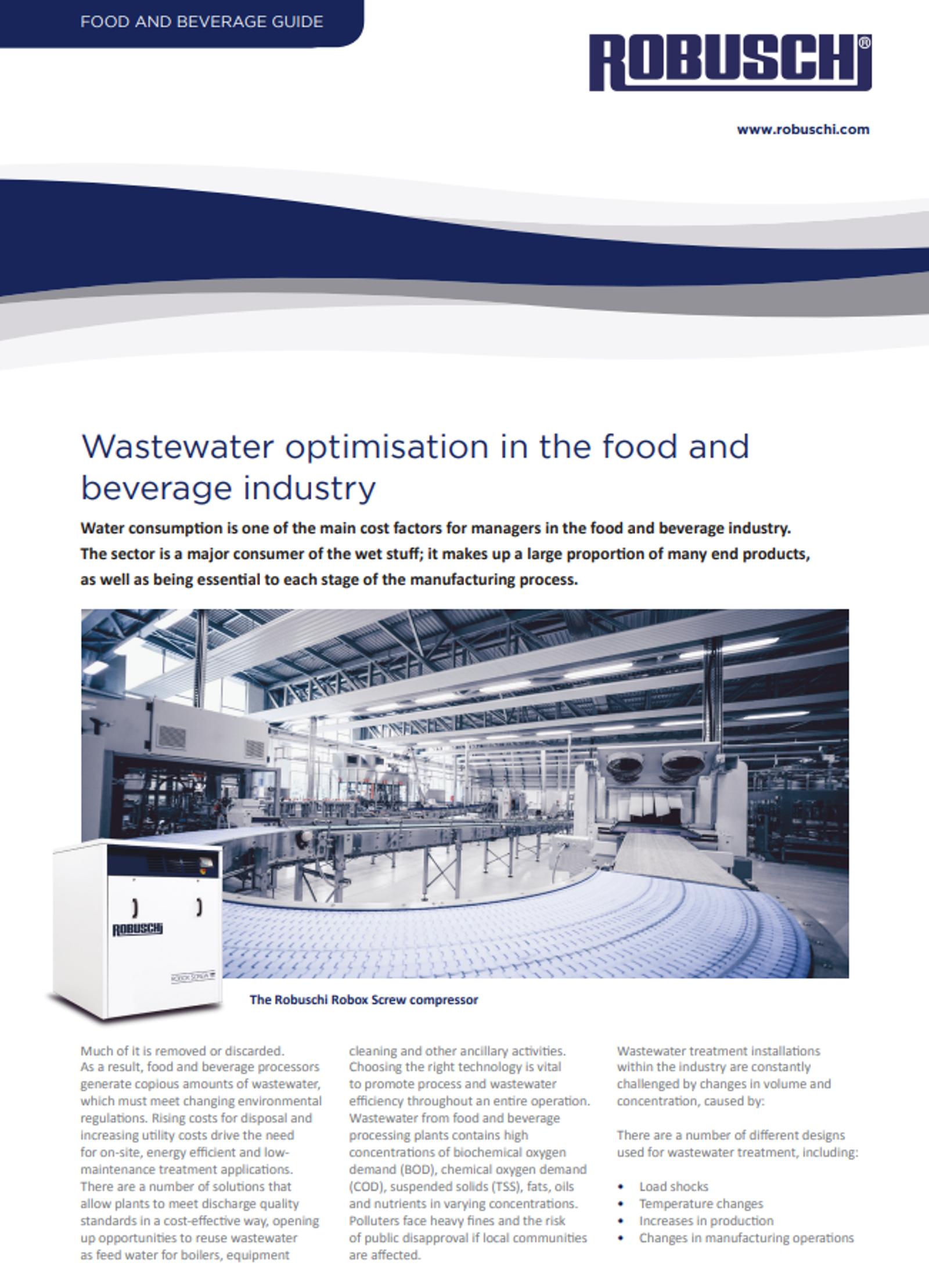
WWT Optimisation in Food & Beverage White Paper

Key Takeaways

  • Water Use Is a Major Cost Driver

Water is used extensively in food and beverage production. Reusing treated wastewater for boilers and cleaning can reduce consumption and costs.

  • Effluent Loads Are Highly

Variable Wastewater contains high levels of BOD, COD, TSS, fats, and nutrients. Load shocks, temperature shifts, and production changes challenge conventional systems.

  • Four-Stage Treatment Process
    • Pre-Treatment: Screens remove large solids.
    • Primary Treatment: Filtration removes up to 60% of suspended solids.
    • Secondary Treatment: Aerobic/anaerobic processes remove organic matter.
    • Tertiary Treatment: Disinfection via chlorine, UV, or ozone.
  • Aeration Is the Cost Center

Aeration systems consume over 60% of total electricity in WWT. Up to 75% of compressed air costs are energy-related. Efficient blowers can cut lifecycle costs significantly.

  • Robuschi Equipment Advantages
    • Smooth, pulsation-free air delivery
    • Low maintenance and high durability
    • Wide turndown capability
    • ISO 8573-1 oil-free certification

Country

Industry

Your request will be forwarded to the relevant individuals to assist with your request.
By clicking 'Send' you are authorizing Generic Brand to contact you so that we may fulfill your request, as well as to communicate with you regarding our products and services.
Terms and Conditions
Privacy Policy

(* required fields)

FAQs

High concentrations of organic matter, fats, oils, and suspended solids vary widely depending on production cycles, making consistent treatment challenging.